

If you suspect lead in Minnesota tap water, standard testing might not be telling you the whole story…
Are you struggling with unexplainable fatigue, stubborn brain fog, or mysterious digestive issues despite doing “everything right”? You eat a clean, organic diet, prioritize your sleep, and your routine blood work comes back completely normal. Yet, you still feel exhausted.
Often, the answer isn’t in your head – it is in your tap water.
In Minnesota, hundreds of thousands of homes still receive drinking water through aging infrastructure containing lead service lines. Municipal water treatment plants may deliver lead-free water to the main street, but toxic heavy metals easily leach into your glass as water sits in your home’s private pipes, brass fixtures, or vintage lead solder.
Because lead is a silent, cumulative neurotoxin with no taste, smell, or color, it can slowly build up in your body for years before causing noticeable health problems. To protect your family and rebuild your health, you must look beyond surface-level testing. You must examine how toxic metals store inside your cellular tissues over time.
Key Takeaways: Protecting Your Household and Rebuilding Your Cellular Health
- Check Your Address for Free: Utilize the Minnesota Lead Inventory Tracking Tool (LITT) or contact your utility provider to verify if your home relies on an aging lead service line.
- Request Free Water Testing: Many local utilities (such as Minneapolis and St. Paul) offer free home lead testing kits upon request.
- Flush and Filter Wisely: Always flush stagnant tap water for 1–5 minutes on cold before drinking. Ensure your filtration pitcher or system is explicitly certified to NSF/ANSI Standard 53 for lead reduction at minimum, or better yet, follow my recommendations below.
- Recognize Blood Test Blind Spots: Standard blood panels only show recent lead exposure (30–40 days). Stored heavy metals require cellular tissue analysis to detect.
- Map Your Cellular Blueprint: A non-invasive Hair Tissue Mineral Analysis (HTMA) reveals your body’s true lead burden, identifies nutrient displacements, and guides a targeted, mineral-based detoxification plan.
Table of Contents
- The Hidden Reality of Lead in Minnesota’s Drinking Water
- Is Your Home at Risk? Mapping Minnesota’s Lead Infrastructure
- How Lead Accumulates in the Body and Brain
- Why Conventional Blood Tests Miss Long-Term Heavy Metal Exposure
- Using Hair Tissue Mineral Analysis (HTMA) to Uncover Stored Metals
- How to Test Your Minnesota Water (And What to Do Next)
- Frequently Asked Questions
The Hidden Reality of Lead in Minnesota’s Tap Water
Lead is a toxic heavy metal that has zero safe threshold in the human body. Public health organizations worldwide, including the Environmental Protection Agency (EPA) and the World Health Organization (WHO), agree: there is no safe level of lead exposure.
While most people connect lead poisoning with peeling paint in homes built before 1978, contaminated drinking water remains one of the most widespread sources of chronic, low-level exposure today.
According to the Minnesota Department of Health (MDH), lead enters municipal tap water through two primary pathways:
- Lead Service Lines (LSLs): The underground utility pipes connecting municipal water mains under the street directly to individual homes or commercial buildings.
- Internal Household Plumbing: Lead solder, vintage brass fixtures, and copper pipes installed before federal lead restrictions took effect in 1986.
Water sitting motionless in these pipes overnight leaches lead particles that dissolve directly into your drinking, cooking, and coffee-brewing water.

Is Your Home at Risk? Mapping Minnesota’s Lead Infrastructure
Many Minnesota homeowners assume their water is pristine because their annual city water report looks clean. However, those municipal reports measure water quality as it leaves the treatment facility, not as it flows out of your kitchen faucet.
The Statewide Goal to Replace Lead Service Lines
Minnesota has established an aggressive statewide goal to identify and replace all lead service lines across the state. While utility replacement programs are underway, complete infrastructure overhaul takes time, leaving millions of homes reliant on older pipes in the interim. The scary thing is that there are many other states affected!
How to Check Your Property
To verify your home’s private service line risk, you can access the Minnesota Lead Inventory Tracking Tool (LITT) Interactive Map. Developed in partnership with the Minnesota Department of Health and the University of Minnesota, this database lets you enter your exact address to view your line’s material status.
Simply enter your address into the map below to determine if your property’s water service line is categorized as:
- Confirmed Lead (Red): Requires immediate physical replacement.
- Galvanized Steel (Red): Pipes that catch and trap historical lead particles over decades and require replacement.
- Unknown Material (Gray): Requires an inspection or self-reporting check.
- Non-Lead (Blue): Identified as copper, plastic, or safe modern materials.
How Lead Accumulates in the Body and Brain
Once ingested, lead does not simply exit your body through normal digestion. Because lead shares a strikingly similar atomic structure to calcium, your intelligence-driven body mistakes lead for a vital mineral. It actively absorbs the metal and stores it deep inside your bones, teeth, brain, and soft tissues.
Over time, this heavy metal storage disrupts critical metabolic pathways:
Neurological and Cognitive Strain
Lead crosses the blood-brain barrier, acting as a potent neurotoxin. In adults, this subtle poisoning presents as persistent brain fog, memory recall issues, chronic headaches, and unexplained mood shifts.
Endocrine and Thyroid Disruption
Lead actively binds to hormone receptor sites, mimicking or blocking thyroid and adrenal signals. This creates systemic hormone imbalances, driving severe fatigue and metabolic slowdown.
Essential Mineral Depletion
Lead displaces critical nutrient minerals including calcium, zinc, iron, and magnesium from cellular binding sites. When toxic metals hijack these positions, cellular energy production (ATP) grinds to a halt.
For a comprehensive look at how heavy metal accumulation impacts your nervous system, read our complete guide on Hair Mineral Analysis and Heavy Metal Toxicity.
Why Conventional Blood Tests Miss Long-Term Heavy Metal Exposure
When individuals suspect heavy metal toxicity, they often ask their doctor for a standard blood test. Unfortunately, relying exclusively on blood work to detect chronic lead toxicity creates a major diagnostic blind spot.
Your body maintains strict blood chemistry homeostasis. Blood is a transportation highway, not a long-term storage facility. Because high levels of lead in circulating blood are immediately life-threatening. Your physiology rapidly shuttles toxic metals out of the bloodstream and buries them deep inside your bones, organs, and hair tissues.
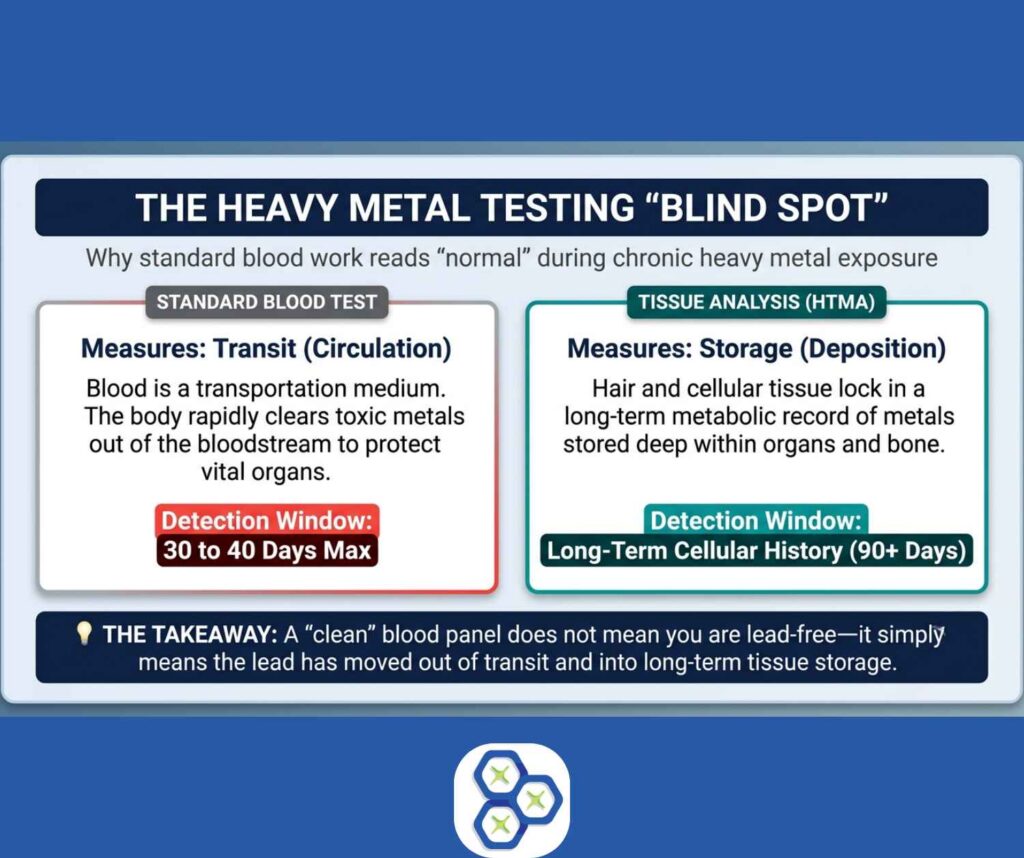
Consequently, lead remains detectable in blood for only 30 to 40 days following an acute exposure. If you have been consuming low levels of lead in your tap water over months or years, your standard blood test will likely read “normal,” even while your body tissues carry a heavy toxic burden.
Explore our in-depth article on Recognizing Toxic Metal Symptoms and Everyday Dietary Toxic Metal Exposure Sources to learn more.
Using Hair Tissue Mineral Analysis (HTMA) to Find Lead in Minnesota Tap Water
To accurately evaluate your heavy metal load, you must assess your body’s tissue history rather than a transient blood snapshot. This is where Hair Tissue Mineral Analysis (HTMA) serves as a vital clinical tool.
As hair develops, it is nourished by blood, lymph, and intercellular fluids. During growth, it undergoes calcification, locking in a clear 90-day metabolic record of mineral retention and heavy metal excretion.
By analyzing a small hair sample, an HTMA reveals:
- True Heavy Metal Excretion: Direct physical tracking of lead, aluminum, cadmium, mercury, and arsenic levels.
- Critical Mineral Ratios: How toxic metals have displaced essential minerals like calcium, magnesium, zinc, sodium, and potassium.
- Adrenal & Thyroid Vitality: How your stress-response glands are managing the burden of heavy metal accumulation.
Using this cellular map, we can design a personalized, mineral-balanced protocol to safely mobilize and eliminate stored lead without causing severe detox crashes.
How to Test for Lead in Your Water (And What to Do Next)
If you suspect your household tap water contains lead, take these immediate, proactive steps:
- Request a Utility Test Kit: Major Minnesota municipalities (including Minneapolis 311 and Saint Paul Regional Water Services) offer free water lead testing kits directly to residents upon request.
- Private Well Owners: If you rely on a private well, the state does not monitor your supply. Order a certified laboratory test kit through the Minnesota Department of Health Certified Labs Directory.
- Flush Cold Water: Never cook, drink, or mix baby formula with warm or hot tap water, as heat accelerates metal leaching. Always flush stagnant cold water for 1 to 5 minutes before drinking.
- Invest in Gravity-Fed Carbon Block & Fluoride Filtration: Standard pitcher filters often fail to eliminate heavy metals or toxic halogen additives. If you are drinking tap or municipal water, I always recommend filtering through a Berkey filtration system equipped with Boroux solid carbon block filters. They trap dissolved lead, heavy metals, and microplastics and offer specialized fluoride filters. This dual combination ensures toxic heavy metals are physically captured before water ever reaches your glass.
- Schedule a Cellular Health Assessment: If you suffer from unexplainable exhaustion or brain fog, take action to uncover what is stored in your tissues.
Frequently Asked Questions About Lead in Water & Heavy Metal Testing
Why did my blood test come back normal if I have lead in my Minnesota tap water or another state?
Standard blood panels only measure lead actively circulating in your bloodstream. Due to toxic heavy metals being highly damaging, your body rapidly clears them from circulation. This usually happens within 30 to 40 days and deposits them into deeper tissues, organs, and bones. A “normal” blood test simply means you haven’t had acute, heavy exposure in the last month. It does not rule out chronic tissue accumulation.
How does Hair Tissue Mineral Analysis (HTMA) detect lead exposure?
Unlike blood, hair is a cellular tissue that locks in a long-term metabolic record as it grows. An HTMA test measures the deposition of heavy metals and mineral balances. They are stored at the cellular level over a 30-60 day window, providing a clearer picture of your body’s true toxic burden.
How can I check if my home has a lead service line in Minnesota?
You can search your specific address using the interactive Minnesota Lead Service Line Inventory Map provided by the state. If your home was built before 1986, it is especially important to verify whether your utility main or private line contains lead or galvanized steel.
What should I do immediately if I suspect lead in my drinking water?
First, avoid drinking or cooking with hot tap water, as heat releases lead from pipes faster. Always flush your cold water tap for 3 to 5 minutes if the water has sat motionless overnight. Next, install an NSF-certified water filter specifically rated for lead removal (NSF/ANSI Standard 53 or 58) and consider ordering an HTMA cellular health assessment to measure your body’s current mineral and heavy metal status.
Hair Analysis to Take Control of Your Energy and Cellular Health
Stop guessing about your heavy metal exposure. Want to identify stored lead in Minnesota tap water, other toxic metals, and restore your vital mineral ratios? Schedule a complimentary consultation with me today to review your symptoms and discuss Hair Tissue Mineral Analysis.